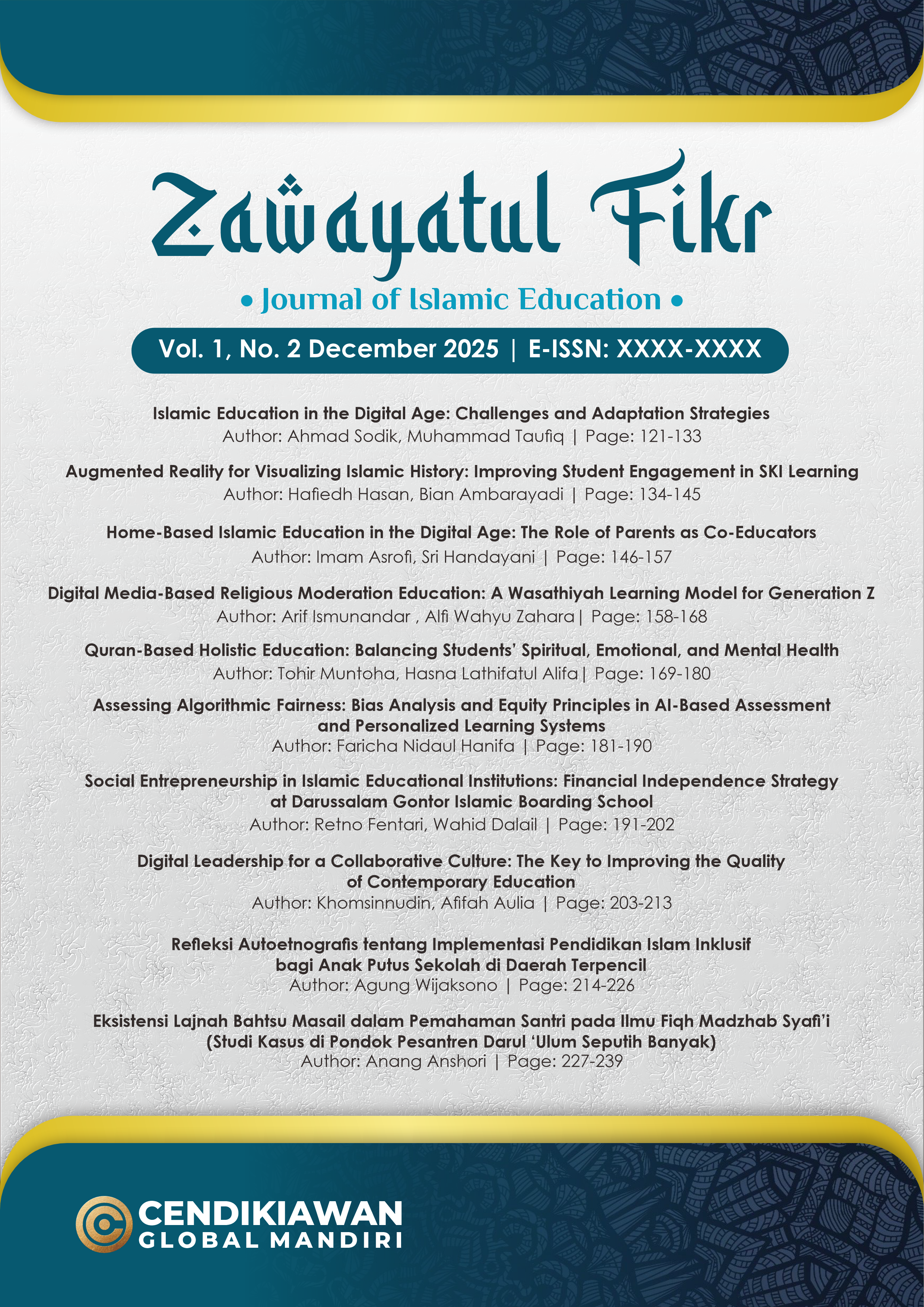
Digital Media-Based Religious Moderation Education: A Wasathiyah Learning Model for Generation Z
Keywords:
religious moderation, wasathiyah, digital media, Generation Z, digital learning, TPACKAbstract
This study develops a digital media based wasathiyah learning model to strengthen religious moderation education for Generation Z in Indonesia. Using a literature study with a descriptive qualitative approach, the study synthesizes scientific works on wasathiyah principles, Gen Z learning characteristics, digital learning theory, and the dynamics of radicalism in the digital era. The resulting model is structured around three integrated pillars wasathiyah content, digital pedagogy, and digital media technology operationalized through the TPACK framework into five components: (1) learning needs analysis; (2) interactive multimedia design (short videos, infographics, podcasts, gamification); (3) platform selection and delivery (LMS, mobile learning, educational social media); (4) active learning strategies (online discussions, digital case studies, project-based learning, peer learning); and (5) learning analytics based evaluation. Implementation, however, faces concrete challenges: unequal internet bandwidth and device availability that limit access to rich media; fragmented platform use that confuses students and increases dropout risk; educators’ limited ability to design moderation-oriented digital activities beyond basic content sharing; competition with algorithm-driven “viral” content that can amplify sensational or polarizing narratives; the presence of misinformation, anonymous propaganda accounts, and echo chambers that normalize intolerance; student engagement fatigue caused by passive scrolling habits and short attention cycles; and ethical-technical constraints such as data privacy, consent, and content moderation procedures in school environments. To address these barriers, the study recommends tiered infrastructure support (including low-bandwidth and offline-ready content), integrated digital–religious literacy programs, educator upskilling for TPACK-based design, creative “shareable” moderation content that remains academically accountable, the formation of a moderate digital ecosystem with clear governance and reporting mechanisms, and multi-stakeholder partnerships involving schools, families, religious authorities, platforms, and government. Overall, this model is expected to strengthen religious moderation education, reduce vulnerability to radical narratives among
References
Ansari, J., & Khan, N. (2020). Exploring the role of social media in collaborative learning the new domain of learning. Smart Learning Environments, 7(9). https://doi.org/10.1186/s40561-020-00118-7
Berková, K., Kubišová, A., Krelová, K., Krpálek, P., & Holečková, L. (2024). The Impact of Socio-Demographic Factors on the Use of Digital Learning Platforms and Forms of Learning by Generation Z Engineering Students. International Journal of Engineering Educator, 14(8), 4–23. https://doi.org/10.3991/ijep.v14i8.50279
Creswell, J. W., & Creswell, J. D. (2018). Research design: Qualitative, quantitative, and mixed methods approaches (5th ed.). SAGE Publications.
Febriani, S. R., & Ritonga, A. W. (2022). The Perception of Millennial Generation on Religious Moderation through Social Media in the Digital Era. Millah: Journal of Religious Studies, 21(2), 313–334. https://doi.org/10.20885/millah.vol21.iss2.art1
Hidayat, W., Nurlaila, N., Purnomo, E., & Aziz, N. (2023). Technological Pedagogical and Content Knowledge (TPACK) in Islamic Religious Education in the Digital Era. Al Hikmah: Journal of Education, 4(1), 93–106. https://doi.org/10.54168/ahje.v4i1.145
History, A. (2024). RELIGIOUS MODERATION EDUCATION : GENERATION-Z AS AGENTS OF CHANGE IN A MULTICULTURAL SOCIETY. TAHIRO: JURNAL PENELITIAN MODERASI BERAGAMA, 1(2), 143–158. https://doi.org/10.14421/lijid.v4i2.2909.1
Hollimon, L., Taylor, K., Fiegenbaum, R., & Seixas, A. (2025). Redefining and solving the digital divide and exclusion to improve healthcare: going beyond access to include availability, adequacy, acceptability, and affordability. Frontiers in Digital Health, 7. https://doi.org/10.3389/fdgth.2025.1508686
Indah, R., Budhiningrum, A., & Afifi, N. (2022). The Research Competence, Critical Thinking Skills and Digital Literacy of Indonesian EFL Students. Journal of Language Teaching and Research, 13(2), 315–324. https://doi.org/10.17507/jltr.1302.11
Janah, S., & Hamami, T. (2022). The Effectiveness of Self-Assessment to Improve Metacognitive Ability in Islamic Religious Education. Correction. https://doi.org/10.31958/jt.v25i2.5911
Jibril, M., & Adedokun-Shittu, N. (2023). Enhancing Education: A Comprehensive Framework for Integrating Technological Pedagogical Content Knowledge (TPACK) Into Teaching and Learning. Indonesian Journal of Multidiciplinary Research, 4(1), 181–188. https://doi.org/10.17509/ijomr.v4i1.72044
Kuputri, N. (2020). Digital Divide: A Critical Approach to Digital Literacy in ‘Making Indonesia 4.0.’ Proceedings of the 2nd Tarumanagara International Conference on the Applications of Social Sciences and Humanities (TICASH 2020). https://doi.org/10.2991/assehr.k.201209.001
Ma’arif, M., Rofiq, M., & Sirojuddin, A. (2022). Implementing Learning Strategies for Moderate Islamic Religious Education in Islamic Higher Education. Journal of Islamic Education, 8(1), 75–86. https://doi.org/10.15575/jpi.v8i1.19037
Mashudi, M., & Hilman, C. (2024). Digital-Based Islamic Religious Education: A New Orientation in Enhancing Student Engagement and Spiritual Understanding. Global International Journal of Innovative Research, 2(10), 2488–2501. https://doi.org/10.59613/global.v2i10.342
Ramadhan, M., Basid, A., & Faizin, N. (2023). Implementing Religious Moderation in Digital Space: Challenges and Opportunities Z Generation. Aqlamuna: Journal of Educational Studies, 1(1), 116–135. https://doi.org/10.58223/aqlamuna.v1i1.234
Reksiana, N., Nata, A., Rosyada, D., Dinia, M., Rahiem, H., & Ugli, A. (2024). Digital Extension of Digital Literacy Competence for Islamic Religious Education Teachers in the Era of Digital Learning. Journal of Islamic Religious Education, 21(2), 402–420. https://doi.org/10.14421/jpai.v21i2.9719
Rizal, D., & Vella, N. (2024). Commodification of Social Media: Digitization of Religion as a Contemporary Da’wah Media. BELIEF: Sociology of Religion Journal, 2(1), 55–65. https://doi.org/10.30983/belief.v2i1.7888
Teknologi, J., & Awalia, F. (2025). Memahami Pola Perilaku Generasi Z di Era Digital. Jurnal Teknologi Dan Sains Modern, 1(2), 15–25.
Wolfowicz, M., Weisburd, D., & Hasisi, B. (2021). Examining the interactive effects of the filter bubble and the echo chamber on radicalization. Journal of Experimental Criminology, 19, 119–141. https://doi.org/10.1007/s11292-021-09471-0
Downloads
Published
Issue
Section
License
Copyright (c) 2025 Zawayatul Fikr: Journal of Islamic Education

This work is licensed under a Creative Commons Attribution-ShareAlike 4.0 International License.