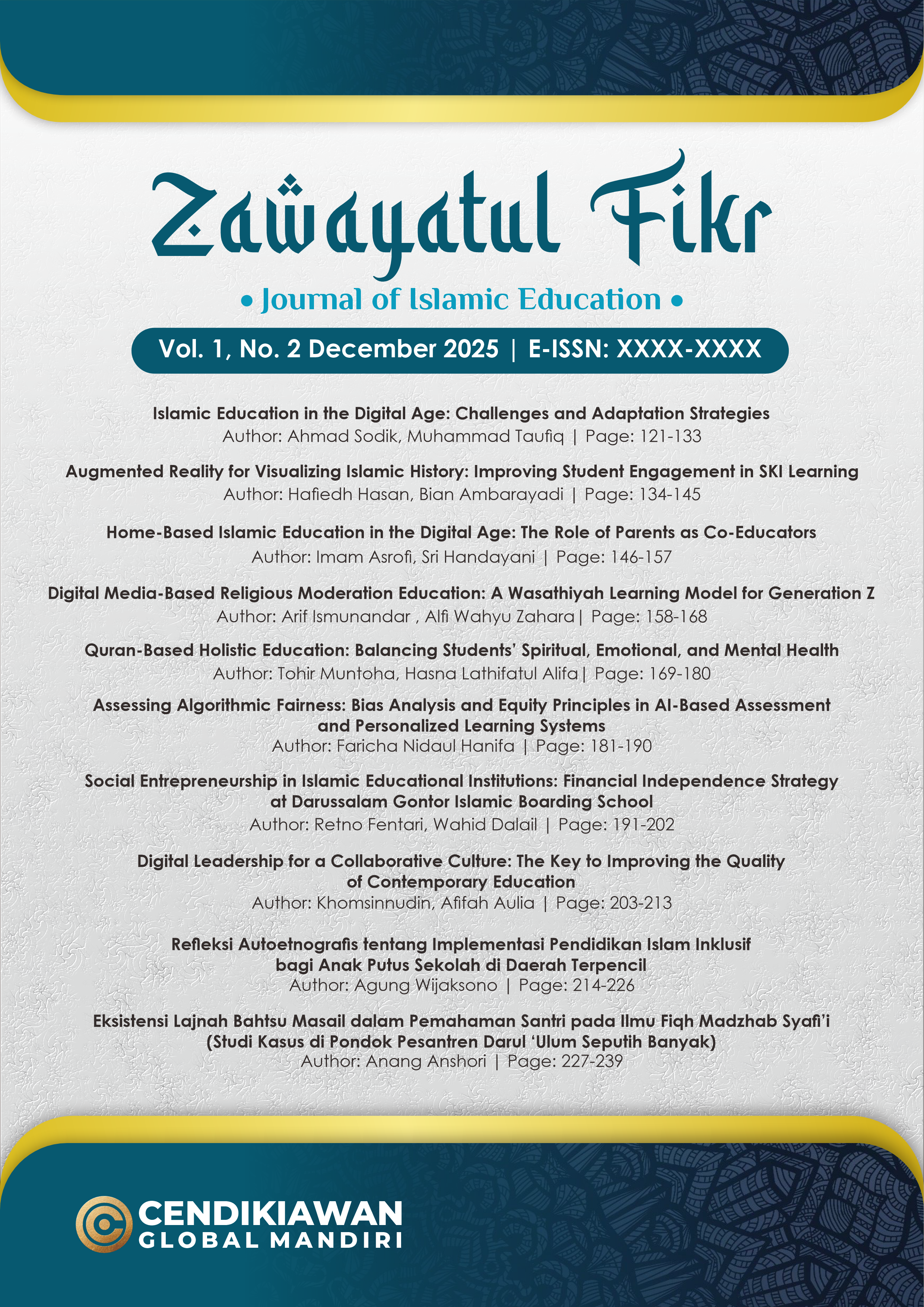
Quran-Based Holistic Education: Balancing Students’ Spiritual, Emotional, and Mental Health
Keywords:
holistic education, Al-Qur'an, mental health, spiritual health, emotional intelligence, Islamic educationAbstract
The mental health crisis of students in the contemporary era demands a comprehensive approach that integrates spiritual, emotional, and mental dimensions in a balanced manner. This study aims to develop a conceptual framework for holistic education based on the Qur’an to address the mental health problems of the younger generation. Using a literature study method with a qualitative descriptive-analytical approach, this study analyzed literature sources including the Qur’an, commentaries, indexed scientific journals, and reference books related to Islamic psychology and holistic education. The results revealed that the Qur’an provides a comprehensive psychological framework that includes the development of spiritual awareness (taqwa, tawakkal, dhikr), emotional intelligence (sabr, syukr, emotional regulation), and mental-cognitive health (cognitive reframing, resilience, tafakkur) integrated within the paradigm of tauhid. These three dimensions form a dynamic, mutually reinforcing system, with spirituality as a meta-framework that provides meaning, emotional intelligence as a mediator of values-behaviors, and mental health as a cognitive capacity that produces a synergistic effect. The implementation of holistic education requires curriculum transformation through an infusion approach, student-centered pedagogy, a spiritually caring school culture, and teacher competency as holistic mentors. Quranic spiritual practices have been shown to have therapeutic effects through neurobiological and psychological mechanisms that create peace of mind and resilience. Longitudinal research confirms that transformation is sustainable because the internalization of values forms a sustainable identity and worldview. The Quran-based holistic education model offers an effective, contextually relevant, and transformative solution to address students’ mental health crisis while achieving the national education goal of developing Indonesians who are faithful, have noble character, and are holistically healthy.
References
Abdalla, M. (2025). Exploring Tarbiyah in Islamic Education: A Critical Review of the English- and Arabic-Language Literature. Education Sciences, 15(5), 559. https://doi.org/10.3390/educsci15050559
Akbayram, H., & Keten, H. (2024). The Relationship between Religion, Spirituality, Psychological Well-Being, Psychological Resilience, Life Satisfaction of Medical Students in the Gaziantep, Turkey. Journal of Religion and Health, 63, 2847–2859. https://doi.org/10.1007/s10943-024-02027-2
Coelho-Júnior, H., Calvani, R., Panza, F., Allegri, R., Picca, A., Marzetti, E., & Alves, V. (2022). Religiosity/Spirituality and Mental Health in Older Adults: A Systematic Review and Meta-Analysis of Observational Studies. Frontiers in Medicine, 9. https://doi.org/10.3389/fmed.2022.877213
Dolcos, F., Hohl, K., Hu, Y., & Dolcos, S. (2021). Religiosity and Resilience: Cognitive Reappraisal and Coping Self-Efficacy Mediate the Link between Religious Coping and Well-Being. Journal of Religion and Health, 60, 2892–2905. https://doi.org/10.1007/s10943-020-01160-y
Dzikra, O., Umayah, U., Meidyansyah, R., Zubaidah, Z., Adam, Y., & Iloakasia, A. (2025). Islamic Spirituality-based Self-guidance Model for Managing Stress among Working College Students. Al-Musyrif: Journal of Islamic Guidance and Counseling, 8(1), 90–104. https://doi.org/10.38073/almusyrif.v8i1.2502
Hamami, T., & Nuryana, Z. (2022). A holistic–integrative approach of the Muhammadiyah education system in Indonesia. HTS Teologiese Studies / Theological Studies, 78(4), 1–10. https://doi.org/10.4102/hts.v78i4.7607
Khodijah, S., Amanda, Q., Prasetiawan, P., & Gunawan, A. (2024). The Urgency of Islamic Education for Mental Health at the Faculty of Islamic Studies, Islamic University 45 Bekasi. Edukasi Islami: Jurnal Pendidikan Islam, 13(2). https://doi.org/10.30868/ei.v13i02.6310
Mumtahanah, S., & Aliza, N. (2022). Prayer Therapy in Islamic Spiritual Guidance Services to Reduce Anxiety Levels in Hospitalized Labor Patients. Al-Ittizaan: Journal of Islamic Counseling Guidance, 5(2), 58–63. https://doi.org/10.24014/ittizaan.v5i2.15943
Owens, J., Rassool, G., Bernstein, J., Latif, S., & Aboul-Enein, B. (2023). Interventions using the Qur’an to promote mental health: a systematic scoping review. Journal of Mental Health, 32(4), 842–862. https://doi.org/10.1080/09638237.2023.2232449
Pandia, V., Noviandhari, A., Amelia, I., Hidayat, G., Fadlyana, E., & Dhamayanti, M. (2021). Association of Mental Health Problems and Socio-Demographic Factors Among Adolescents in Indonesia. Global Pediatric Health, 8. https://doi.org/10.1177/2333794x211042223
Sholihah, M., Cahyani, C., & Ningsih, Y. (2024). Qur’anic Counseling with Motivational Guidance QS. Al-Baqarah Verses 155-156, in Overcoming Anxiety in One of the Students. Dirasah International Journal of Islamic Studies, 2(1), 87–95. https://doi.org/10.59373/drs.v2i1.32
Tejada-Gallardo, C., Blasco-Belled, A., Torrelles-Nadal, C., & Alsinet, C. (2020). Effects of School-based Multicomponent Positive Psychology Interventions on Well-being and Distress in Adolescents: A Systematic Review and Meta-analysis. Journal of Youth and Adolescence, 49, 1943–1960. https://doi.org/10.1007/s10964-020-01289-9
Wijaya, I., Tahir, M., Syahrir, S., & Handari, S. (2024). The Role of Piety (Taqwa) and Gratitude (Syukur) in Islam on Human Emotional Intelligence. Pharos Journal of Theology, 105(2), 1–13. https://doi.org/10.46222/pharosjot.105.24
Yanto, F., Meliana, N., Rosodor, S., Saifullah, R., & Etikoh, N. (2025). The Effectiveness of Internalizing Moral Values through Qur’anic Learning at Children’s Boarding School. Ngaos: Journal of Education and Learning, 3(1), 12–20. https://doi.org/10.59373/ngaos.v3i1.93
Downloads
Published
Issue
Section
License
Copyright (c) 2025 Zawayatul Fikr: Journal of Islamic Education

This work is licensed under a Creative Commons Attribution-ShareAlike 4.0 International License.