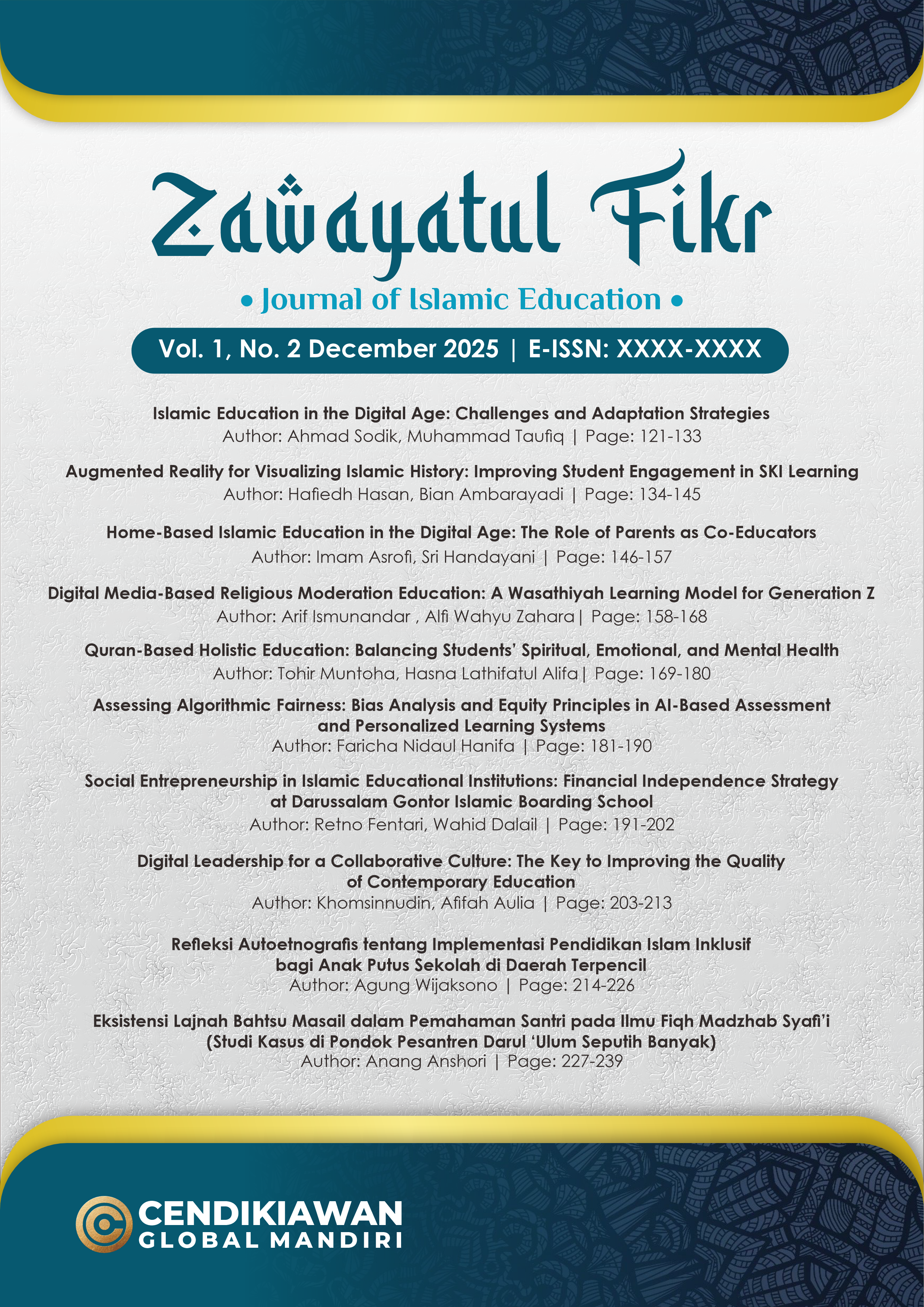
Assessing Algorithmic Fairness: Bias Analysis and Equity Principles in AI-Based Assessment and Personalized Learning Systems
Keywords:
algorithmic bias, algorithmic fairness, AI in education, automated assessment, personalized learning, educational equityAbstract
The application of artificial intelligence (AI) in education can improve efficiency and consistency through automated assessment and personalized learning, yet it can also introduce algorithmic bias that amplifies educational inequities. This study examines how algorithmic bias manifests in AI-based assessment systems and personalized learning, and it proposes an algorithmic fairness framework to support equitable implementation of educational technology. This study applies a library-based desk study using a qualitative descriptive-analytical approach. It systematically collects and documents evidence from indexed journal articles (Scopus, Web of Science, IEEE Xplore, ACM Digital Library), textbooks on AI ethics and educational technology, and policy reports from UNESCO and OECD using targeted keywords, then it selects sources based on relevance and credibility. The analysis uses content analysis that (1) identifies core themes on bias sources, injustice manifestations, and fairness frameworks, (2) categorizes findings across technical, social, and ethical dimensions, (3) critically interprets patterns and gaps, and (4) synthesizes a conceptual framework with practical recommendations. The findings show that bias arises in automated essay scoring (AES) and adaptive learning through unrepresentative training data, proxy variables, and feedback loops that reinforce prior disparities. The proposed framework integrates individual, group, and counterfactual fairness, and it clarifies the ethical trade-offs that emerge when these criteria conflict. Bias mitigation strategies include stronger transparency and documentation, participatory design with affected stakeholders, routine algorithmic audits, human-in-the-loop review for high-stakes decisions, and AI literacy training for educators. This study offers practical guidance for developers, educators, and policymakers to build fairer and more transparent educational AI systems.
References
Alsagri, H., & Sohail, S. (2024). Evaluating the role of Artificial Intelligence in sustainable development goals with an emphasis on “quality education.” Discover Sustainability, 5(1), 458. https://doi.org/10.1007/s43621-024-00682-9
Bagunaid, W., Chilamkurti, N., & Veeraraghavan, P. (2022). AISAR: Artificial Intelligence-Based Student Assessment and Recommendation System for E-Learning in Big Data. Sustainability, 14(17), 10551. https://doi.org/10.3390/su141710551
Bird, K., Castleman, B., & Song, Y. (2024). Are algorithms biased in education? Exploring racial bias in predicting community college student success. Journal of Policy Analysis and Management, 43(2), 456–485. https://doi.org/10.1002/pam.22569
Bogina, V., Hartman, A., Kuflik, T., & Shulner-Tal, A. (2021). Educating Software and AI Stakeholders About Algorithmic Fairness, Accountability, Transparency and Ethics. International Journal of Artificial Intelligence in Education, 32(3), 808–833. https://doi.org/10.1007/s40593-021-00248-0
Cooke, F., Dickmann, M., & Parry, E. (2022). Building sustainable societies through human-centred human resource management: emerging issues and research opportunities. The International Journal of Human Resource Management, 33(1), 1–15. https://doi.org/10.1080/09585192.2021.2021732
Idowu, J. (2024). Debiasing Education Algorithms. International Journal of Artificial Intelligence in Education, 34(4), 1–31. https://doi.org/10.1007/s40593-023-00389-4
Khosravi, H., Shum, S. B., Chen, G., Conati, C., Tsai, Y. S., Kay, J., Knight, S., Maldonado, R. M., Sadiq, S., & Gašević, D. (2022). Explainable Artificial Intelligence in education. Computers and Education: Artificial Intelligence, 3, 100074. https://doi.org/10.1016/j.caeai.2022.100074
Kizilcec, R. F., & Lee, H. (2020). Algorithmic Fairness in Education. In arXiv preprint. https://doi.org/10.48550/arXiv.2007.05443
López-Meneses, E., López-Catalán, L., Pelícano-Piris, N., & Mellado-Moreno, P. (2025). Artificial Intelligence in Educational Data Mining and Human-in-the-Loop Machine Learning and Machine Teaching: Analysis of Scientific Knowledge. Applied Sciences, 15(2), 772. https://doi.org/10.3390/app15020772
Matthews, S., Hudzina, J., & Sepehr, D. (2022). Gender and Racial Stereotype Detection in Legal Opinion Word Embeddings. Proceedings of the 2022 AAAI/ACM Conference on AI, Ethics, and Society, 12026–12033. https://doi.org/10.48550/arXiv.2203.13369
Munappy, A., Bosch, J., Olsson, H. H., Arpteg, A., & Brinne, B. (2022). Data management for production quality deep learning models: Challenges and solutions. Journal of Systems and Software, 191, 111359. https://doi.org/10.1016/j.jss.2022.111359
Murikah, W., Nthenge, J., & Musyoka, F. (2024). Bias and Ethics of AI Systems Applied in Auditing - A Systematic Review. Scientific African, 25, e02281. https://doi.org/10.1016/j.sciaf.2024.e02281
Nezami, N., Haghighat, P., Gándara, D., & Anahideh, H. (2024). Assessing Disparities in Predictive Modeling Outcomes for College Student Success: The Impact of Imputation Techniques on Model Performance and Fairness. Education Sciences, 14(2), 136. https://doi.org/10.3390/educsci14020136
Taşkın, M. (2025). Artificial Intelligence in Personalized Education: Enhancing Learning Outcomes Through Adaptive Technologies and Data-Driven Insights. Human Computer Interaction, 9(1).
Yang, K., Raković, M., Li, Y., Guan, Q., Gašević, D., & Chen, G. (2024). Unveiling the Tapestry of Automated Essay Scoring: A Comprehensive Investigation of Accuracy, Fairness, and Generalizability. In arXiv preprint. https://doi.org/10.48550/arXiv.2401.05655
Downloads
Published
Issue
Section
License
Copyright (c) 2025 Zawayatul Fikr: Journal of Islamic Education

This work is licensed under a Creative Commons Attribution-ShareAlike 4.0 International License.